


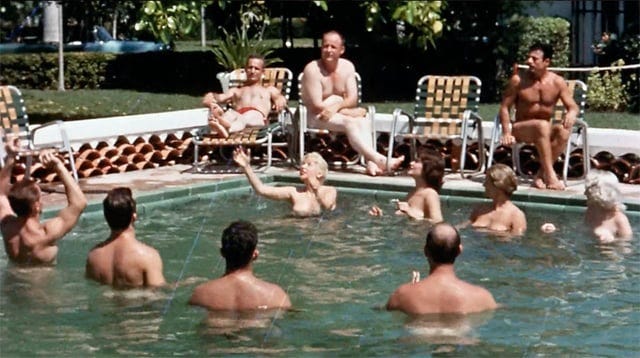
Picture a nudist park in 1965. Sunshine, volleyball, a very wholesome vibe, and a gate that stays politely shut if you are an unmarried man. Now picture those unmarried men standing outside with their towels, wondering what they did to deserve this.
Every October, LGBTQIA+ History Month gives us a reason to dig up stories we were never handed. Naturism has its own tidy origin tale: ancient Greeks, German health reformers, lots of fresh air. Queer people, if they appear at all, get a footnote. That has it backwards. Gay and lesbian nudists helped build this movement, often while the movement was busy telling them to wait outside.
Queer naturism history started long before Stonewall
The roots run deeper than most people realize. In Germany, Adolf Brand began publishing Der Eigene in 1896, widely considered the world’s first homosexual periodical. In 1903 he founded a circle called the Gemeinschaft der Eigenen, and nudism and the Freikörperkultur (free body culture) ideal were part of its vision [1]. Brand was a complicated figure, but the point stands: nakedness and queer liberation have been tangled together from the start.
In the United States, Jan Gay was openly lesbian and directed the Out-of-Door Club, a nudist colony of about 50 people in Highland, New York. She published On Going Naked in 1932, wrote the script for the documentary This Nude World, and was dubbed “the leader of nudism in New York” by newspapers [2]. A lesbian, running the nudists, in the 1930s. Let that sink in.
Then there were the margins. When gay gatherings were policed, men went where the police weren’t. Hanlan’s Point on Toronto Island became a refuge as early as the 1940s, and the dunes of Cherry Grove and Fire Island Pines followed in the 1950s and 60s [3]. Compared with the dim bars and bathhouses that dominated gay life, the beach offered something radical: daylight.
The nudist press of the era danced around all of it. When Mr. Nudist launched in 1968, it complained about prejudice against “the single male nudist,” a phrase doing heroic work because the publishers didn’t yet dare print the word gay [3].
How gay nudists built the free beach movement
Here’s the irony. Mainstream nudism spent the mid-century selling itself as a haven for the nuclear family, and the pitch came with fine print. Many clubs restricted single men, which locked out most gay men. Murray Kaufman, a pioneering gay naturist organizer, put it bluntly in 1992: the policy “effectively excludes gay men and is discriminatory” [3].
Meanwhile, the free beach movement of the 1970s was winning public clothing-optional beaches, and gay activists were frequently out front. They had been schooled by gay liberation in organizing and facing down police harassment. Lee Baxandall, the straight founder of The Naturist Society, said so himself in 1981: “Gays on the nude beach have often led” [3]. Those beaches then benefited every naturist, including the ones who never sent a thank-you note.
Gay naturist organizations and the fight to belong
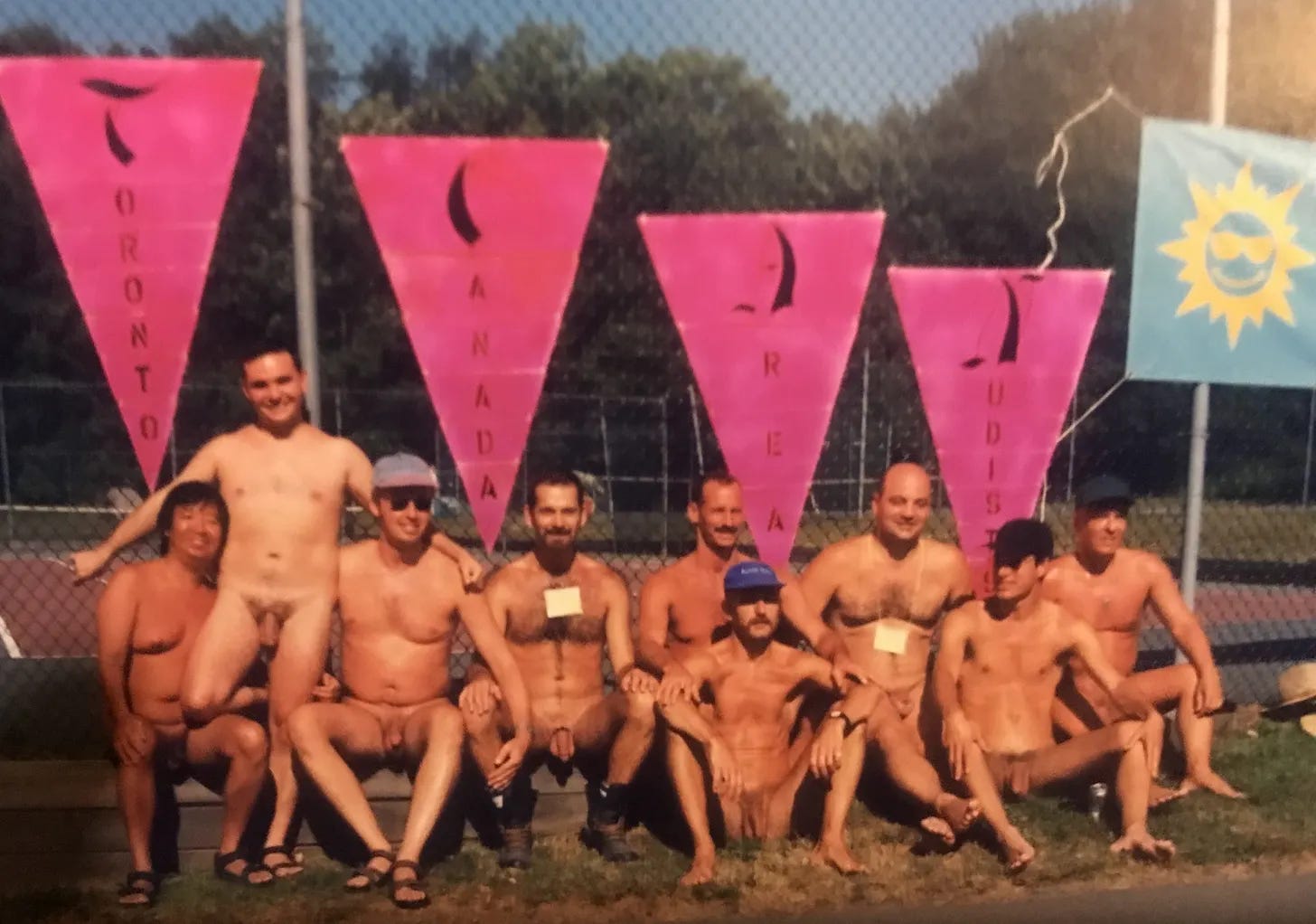
By the late 1970s, small groups were forming on their own: the Gay Bares of Philadelphia, the Everglade Rawhides in Miami, Key West Naturists, and Lambda Soleil near Washington, D.C. [3][4]. (Yes, the names are fantastic. Gay history has never lacked for branding.) Their shared goal was “social, nonsexual nudity” without discrimination [3].
Baxandall’s Naturist Society, founded in 1980, gave them a bigger home. Kaufman had been quietly hosting nude socials for gay men while staying mostly closeted within his own club, and Baxandall nudged him to come out and lead. Gay and Lesbian Naturists launched in 1984 as a special interest group. By 1992 it had gone independent as Gay Naturists International (GNI), dropping “Lesbian” from its name after lesbian naturists largely organized in their own spaces [3].
Then came the AIDS crisis. Through the late 1980s and 90s, GNI’s annual gatherings grew into events drawing hundreds of men, at a time when media and government treated gay bodies as vectors of disease. The gatherings offered a counter-narrative: men of all ages, sizes, and abilities, including men carrying the marks of illness, walking together without shame [3].
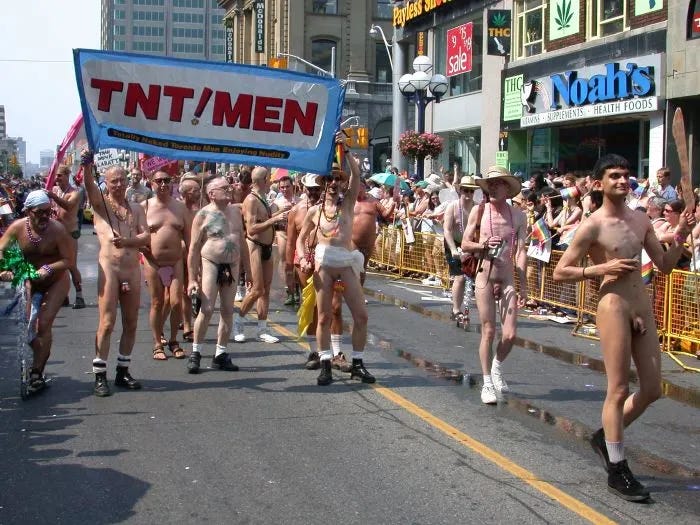
North of the border, the stakes were legal. A Toronto group called TNT!MEN fought police raids on its naked dance events and won in 2000, establishing that social nudity among consenting adults in an adult space was lawful. That momentum helped lead the city to protect clothing-optional Hanlan’s Point in 2002 [3].
Why LGBTQ+ naturism history still matters
First, honesty. Tell the story of naturism without the people who fought for the beaches and you are teaching a version that never happened.
Second, the record has gaps, and we should say so. Most of the documented history above centers on gay men. The stories of lesbian, bisexual, trans, nonbinary, intersex, and asexual naturists are thinner in the archives. That is a reason to collect them, not a reason to shrug. Institutions like the American Nudist Research Library preserve this material, and more voices should be recorded while the people who lived it can still tell it.
Third, old habits die hard. In some places, single-man policies and “family friendly” branding can still work like a velvet rope, and the lazy equation of nudity with sex remains a favorite weapon against any marginalized group. Gay naturists have wrestled with that line for decades. GNI’s own position is that sex is natural but is not the same thing as naturism, which is a more grown-up conversation than the panic we usually get [3].
Finally, the heart of it. Curtis Atkins, whose history of GNI is the backbone of this piece, argues that undressing among friends echoes the act of coming out. You set down the armor a closeted life requires [3]. That is not a coincidence. It is why queer people were drawn to naturism and why they fought so hard for places to practice it.
Modern naturism says everyone is welcome. This history is the receipt. Remembering it is how we keep that promise honest, and how we make sure the next person standing outside the gate gets let in. The sun, after all, has never asked for a plus-one or checked anyone’s ID.
References
Utoronto Journal Library, “A Journal for Manly Culture: An Exploration of the World’s First Gay Periodical” (jps.library.utoronto.ca); GLBTQ Archive, Adolf Brand entry (glbtqarchive.com)
Michael Waters, “Jan Gay: The Lesbian Sex Researcher That History Forgot,” OutHistory (outhistory.org)
Curtis Atkins, “Out of the closet and out of their clothes: The history of Gay Naturists International,” Planet Nude, 2026, citing Mr. Nudist (1968), Lee Baxandall in Clothed With the Sun (1981), and Leslie Rollins in Nude and Natural (1992)
TheNGINE, “History of Gay Naturism” (thengine.org)
Thank you for shining light on this part of our shared history. When we include the contributions of LGBTQ naturists, we get a clearer, more honest picture of how these nude spaces were created and protected. It’s a reminder that visibility matters.
Although I'm not gay, I stand behind you.